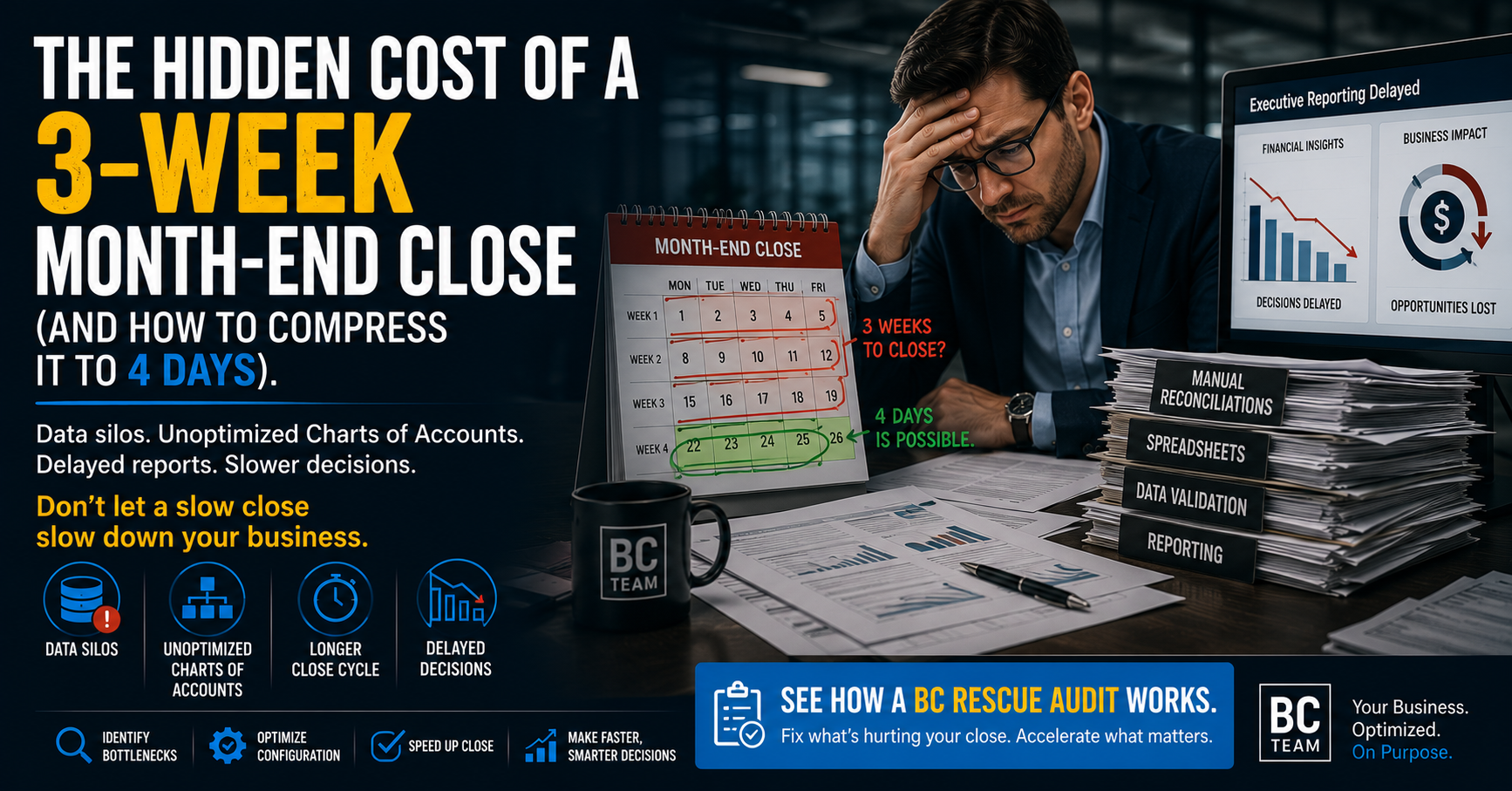
It's the 19th of the month. Your Controller is still chasing down three GL adjustments from last month's close. Your CEO wants a margin number for the board deck that's due Friday, and the honest answer is "we won't know for sure until we close" — which won't happen until next week.
If that sounds familiar, you're not alone, and you're not stuck with it. A 21-day close isn't a law of nature for mid-market companies running Business Central. It's a symptom, and it's almost always a fixable one.
Here's what a close that long is actually costing you, why it happens inside BC specifically, and what compressing it down to 4 days really looks like.
The real cost isn't the accounting team's time
Everyone focuses on the labor cost of a slow close — the overtime, the late nights, the burnout on the finance team. That's real, but it's not the expensive part.
The expensive part is what happens upstream. When your close takes three weeks, your management team is running the business on financials that are, on average, 5 to 6 weeks old by the time the next set of numbers replaces them. Pricing decisions, hiring decisions, capital allocation, project bids — all of it gets made against a rearview mirror instead of a windshield.
- A Controller flagging a margin slip in week 1 of a problem can course-correct it. A Controller flagging it in week 4, after a delayed close finally surfaces it, is reacting to a quarter that's already lost.
- Banks and lenders asking for current financials on a covenant test don't care that your close "usually" finishes by the 20th — a slow close is a real risk factor in financing conversations.
- Job costing teams in construction and manufacturing lose the ability to catch a job running over budget while there's still time to do something about it.
A slow close isn't an accounting inconvenience. It's a strategic visibility problem with a dollar figure attached, even if nobody's calculated it.
Why this happens inside Business Central specifically
BC is fully capable of a fast, clean close. When it doesn't deliver one, the cause is almost always one of three things — and usually it's a combination of all three.
1. Data silos outside the system
This is the most common root cause we see. Job costs tracked in a separate spreadsheet because the field team "finds BC clunky." Inventory adjustments held in a shared Excel file until someone remembers to enter them. Expense approvals routed through email instead of the system.
- Every one of these silos has to be manually reconciled back into BC before close — and that reconciliation is where days disappear.
- The data isn't wrong, exactly. It's just living in the wrong place, which means someone has to manually move it into the G/L Entry table before the numbers can be trusted.
- The more departments running parallel spreadsheets, the more close day becomes a scavenger hunt instead of a process.
2. A bloated, unoptimized Chart of Accounts
A Chart of Accounts that's grown organically over several years — accounts added for one-off needs and never retired, inconsistent posting groups, sub-ledgers that don't cleanly tie back to the G/L — forces your accounting team into heavy manual adjustment work every single month.
- If your trial balance has 40+ dormant or duplicate accounts still receiving stray postings, every reconciliation takes longer because there's more noise to sort through.
- Inconsistent posting groups are a classic source of variances that take hours of manual tracing to resolve — every month, on a recurring basis.
- A clean, intentional Chart of Accounts is the single highest-leverage thing most companies can fix, and it's almost never revisited after go-live.
3. Misconfigured or underused Dimensions
Dimensions are supposed to make reporting faster, not slower — but a Dimension setup that's grown without discipline does the opposite. We regularly see companies running 10+ dimensions where 3 or 4 are actually used in any report anyone looks at.
- Excess dimension combinations bloat the Dimension Set Entry table, which makes standard financial reports slower to generate at exactly the moment — close week — when speed matters most.
- Underused dimensions mean your team is manually tagging or correcting dimension values during close instead of having them flow through automatically from clean transaction entry.
- Properly configured dimensions should let you slice a P&L by job, location, or department in seconds. Poorly configured ones turn that into a half-day exercise.
What a 4-day close actually requires
Compressing a 21-day close to 4 days isn't about working faster. It's about removing the manual reconciliation work that's eating most of those three weeks in the first place.
- Eliminate the silos. Get job costs, inventory adjustments, and expense data flowing directly into BC at the point of transaction, not reconciled in afterward. If a workflow feels clunky enough that people are avoiding it, the workflow needs fixing — not a permanent spreadsheet workaround.
- Rationalize the Chart of Accounts. Audit every account for actual use. Consolidate or retire what's dormant. Standardize posting groups so reconciliation stops being a manual investigation every month.
- Clean up Dimensions. Identify which dimensions actually drive decisions and which were set up once and forgotten. Fewer, well-maintained dimensions outperform a sprawling set every time.
- Automate the recurring adjustments. Recurring journals, allocation templates, and standing entries that get rebuilt manually every month are pure waste — BC can run these automatically once they're set up correctly.
None of this requires new software or a re-implementation. It requires a clear-eyed audit of where the time is actually going, and a deliberate cleanup of the architecture underneath the close.
What this looks like in practice
We worked with a mid-sized distribution company whose close had crept from roughly 8 days at go-live to 21 days, four years in. Inventory adjustments were tracked in a shared spreadsheet because the warehouse team found the BC mobile workflow too slow. Their Chart of Accounts had over 50 dormant accounts still catching postings from a legacy integration. They were running 9 dimensions, of which 3 showed up in any report leadership actually used.
After closing the inventory silo, consolidating the Chart of Accounts, and cutting the dimension set down to the 3 that mattered — plus automating four recurring journal entries that had been rebuilt by hand every month — their close came down to 4 days. Same ERP. Same team. Same transaction volume. Different architecture underneath it, and a finance team no longer spending three weeks a month firefighting instead of analyzing.
This isn't an unfixable reality — it's a signal
If your close still takes three weeks, that's not a fact about your business. It's a signal that your system needs a realignment, and it's one of the most fixable problems in a mid-market finance function.
A BC Rescue Audit is built exactly for this. We go into your actual environment — your Chart of Accounts, your Dimensions, your data silos, your manual workarounds — and identify the precise bottlenecks stalling your close. You walk away with a clear, prioritized roadmap to a faster, more trustworthy reporting engine, not a vague recommendation to "use the system more."
You don't have to live with stale numbers and a finance team that spends three weeks a month reconciling instead of advising. Find out what's actually slowing you down.