ERP Rescue: Lessons from Projects Stalled for Years
- Feb 18
- 3 min read
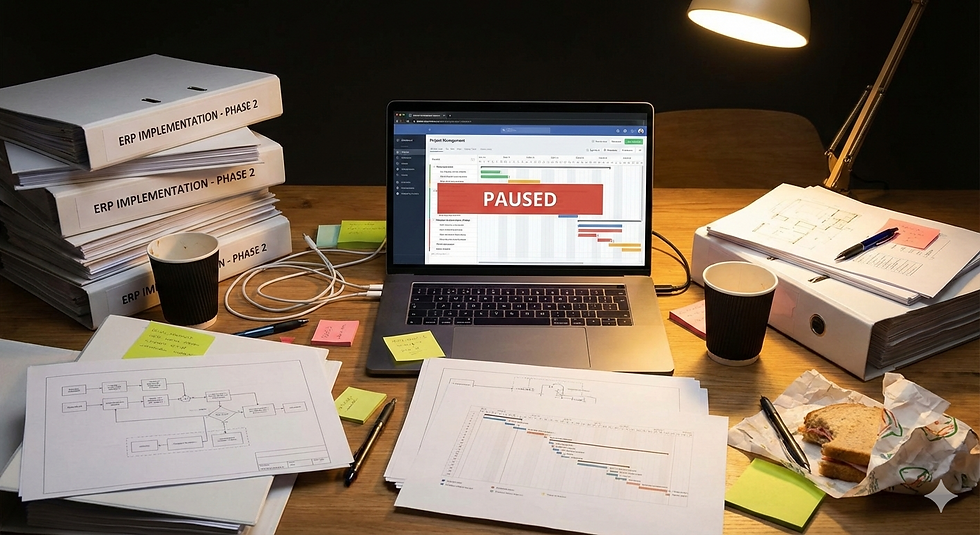
Most ERP projects don’t fail outright — they stall.
What begins as a strategic investment slowly turns into a source of frustration. The system goes live, but confidence never fully arrives. Reporting feels unreliable. Manual workarounds creep back in. Customizations accumulate. Leadership stops asking the ERP for answers and starts relying on spreadsheets again.
In many organizations running Microsoft Dynamics NAV or Business Central, this pattern is far more common than teams want to admit. The good news? Stalled ERP projects can be rescued — without replacing the system.
The Silent Cost of a Stalled ERP
ERP fatigue doesn’t announce itself loudly. It shows up quietly:
Finance teams spending hours reconciling data outside the system
Operations bypassing workflows to “get things done”
IT maintaining customizations no one fully understands
Leadership questioning whether the ERP investment was worth it
Over time, these issues create real costs: slower close cycles, weaker controls, poor visibility, higher audit risk, and declining user adoption. The ERP still runs, but it no longer drives the business forward.
Common Patterns Behind ERP Rescue Stories
After working with many organizations in long-running ERP environments, several root causes appear again and again.
1. Customization Without Governance
Customizations often solve short-term pain but create long-term risk when they are added without structure. Over years, businesses inherit code that no longer matches current processes, breaks during upgrades, or blocks standard functionality.
2. Unclear Ownership
When no one clearly owns ERP decisions, systems drift. Finance, operations, and IT all influence changes — but no single group governs architecture, controls, or data standards.
3. Manual Workarounds Becoming the Norm
Spreadsheets, shadow systems, and off-platform approvals often return because users don’t trust the ERP outputs. Once this happens, the system becomes a record-keeping tool instead of an operational backbone.
4. Lack of Post-Go-Live Strategy
Many implementations focus heavily on go-live but lack a long-term roadmap. Without continuous optimization, training, and review, even a solid ERP foundation degrades over time.
ERP Rescue Is Not a Re-Implementation
One of the biggest misconceptions about ERP rescue is that it requires starting over. In reality, most stalled projects don’t need replacement — they need system stabilization.
Stabilization is a structured recovery approach focused on restoring clarity, control, and confidence within the existing ERP environment.
It starts with asking better questions:
Does the system reflect how the business operates today?
Which customizations add value — and which add risk?
Are workflows enforcing controls or being bypassed?
Can leadership trust the numbers coming out of the system?

What System Stabilization Actually Looks Like
Effective ERP rescue follows a deliberate sequence:
Step 1: Assessment
Review system architecture, customizations, security, workflows, financial structure, and reporting. The goal is not blame — it’s visibility.
Step 2: Rationalization
Identify what to keep, fix, redesign, or retire. Many organizations are surprised how much complexity can be reduced without disrupting operations.
Step 3: Control & Clarity
Strengthen approvals, permissions, and financial processes. Stabilization restores governance so the system supports accountability rather than bypassing it.
Step 4: Adoption & Confidence
Users re-engage when the system works as expected. Training becomes meaningful again, and leadership regains trust in the data.
Results Organizations See After ERP Rescue
When stabilization is done correctly, the impact is tangible:
Fewer manual workarounds
Cleaner audit trails
Improved month-end close cycles
More reliable reporting
Reduced customization risk
Stronger executive confidence
Most importantly, the ERP shifts from being a liability back into a strategic asset.
The Bigger Lesson
ERP rescue stories all point to the same truth:
ERP success is not about adding more software.
It’s about strengthening what already exists.
Organizations that treat ERP as a living system — one that requires governance, optimization, and ongoing leadership alignment — consistently outperform those that chase replacements or quick fixes.
Stalled ERP projects are not failures. They are signals. With the right stabilization approach, years of frustration can be turned into long-term control, scalability, and measurable ROI.
✅ Take Action with The BC Team
If your ERP feels stalled, frustrating, or unreliable, The BC Team can help.
With decades of experience in Microsoft Dynamics NAV and Business Central, Taylor McEachnie and The BC Team specialize in:
System stabilization and workflow optimization
Customization rationalization
Financial and operational governance
User adoption and training
Don’t let your ERP investment sit idle. Reclaim control, efficiency, and ROI today.
📧 Contact us: bc@bcteam1.com
📞 Call: 226-747-7679
🌐 Visit: www.bcteam1.com


Comments