top of page

How Business Central calculates average cost — and why it matters

  • 1 day ago
  • 2 min read

Updated: 3 hours ago

One of the most common questions we hear from clients is: how does Business Central actually arrive at an item's average cost? The answer is straightforward once you see it in action, so we've put together a two-day worked example to make the logic concrete.


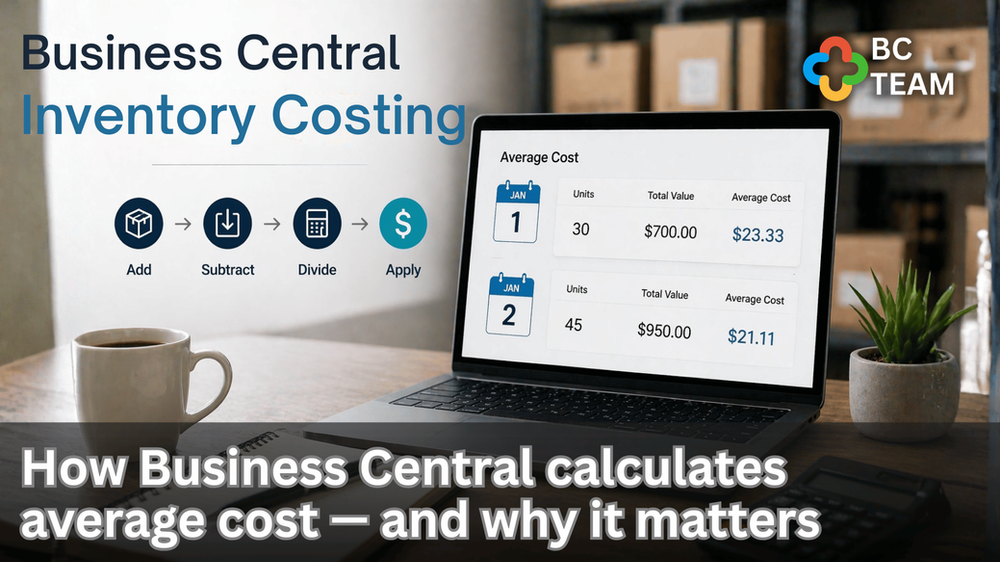
At the close of each average cost period, Business Central follows these four steps:


  1. Start with the item's cost at the beginning of the period.


  2. Add all inbound costs posted during the period — purchases, sales returns, positive adjustments, and production or assembly outputs.


  3. Subtract the cost of any outbound transactions that were fixed-applied to specific receipts (typically purchase returns and negative outputs).


  4. Divide the resulting total value by the total inventory quantity at period end, excluding any decreases still being valued.


The calculated average cost is then applied to all inventory decreases (shipments, consumption) whose posting dates fall within the period. For inventory increases that are fixed-applied to specific decreases, Business Central carries the average cost forward from the increase to the decrease.

Close-up view of inventory items on warehouse shelves
Inventory items stored on warehouse shelves, showing stock levels

Now let's see this play out over two days for a single item.


Day 1 — January 1, 2026


We open the day with 10 units on hand at $20.00 each ($200.00). During the day we receive a purchase of 20 more units at $25.00 each ($500.00). The combined inventory is now 30 units worth $700.00 — an average cost of $23.33 per unit.


That average cost is applied to the sales shipment of 15 units, leaving 15 units in inventory valued at $350.00 at day's end.


table 1


Day 2 — January 2, 2025


Day 2 opens with those 15 units carried forward at $23.33 each ($350.00). We receive 30 more units at $20.00 each, bringing inventory to 45 units worth $950.00 — an updated average cost of $21.11 per unit ($950 ÷ 45).


The $21.11 average cost is applied to the day's sales shipment of 10 units, and the remaining 35 units close at $21.11 each for a total inventory value of $738.89.


table 2

Key takeaways


Notice that each day's average cost is recalculated fresh — the prior period's average becomes the opening cost of the next, not a permanent fixture. This means every purchase receipt, regardless of price, immediately influences the average cost applied to outbound entries for that period. In volatile markets or high-volume environments, that recalculation cadence can have a meaningful impact on your cost of goods sold.


If your team uses locations or variants, Business Central applies this same logic at that granular level — each location/variant combination maintains its own average cost pool.


Want to go deeper?

The BC team is here to help — whether you're setting up costing methods for the first time, troubleshooting unexpected COGS figures, or planning a migration. Check out our full library of Business Central how-to guides, or reach out directly.


Comments


bottom of page